

Something very cool is happening in animal science… researchers (and animal care professionals!) are not satisfied anymore with just ensuring animals don’t suffer. We want to know if animals are FLOURISHING – whether they experience something we might recognise as joy?
And as it turns out, the answer appears to be YES!
For decades, the scientific community was cautious about attributing positive emotional states to non-human animals, wary of being accused of anthropomorphism. That caution is now giving way to something way more interesting – curiosity!
A growing movement of researchers is designing rigorous experiments to detect and measure what scientists call “positive affect” – meaning genuine states of pleasure, excitement, and wellbeing – across an enormous range of species.

The intellectual foundation for this shift was laid by beloved neuroscientist Jaak Panksepp, whose incredible work identified seven primary emotional systems shared across all mammals – including PLAY, SEEKING, and CARE. His research established that the subcortical brain structures generating these emotional states in humans are evolutionarily ancient, present in species as diverse as rats, dolphins, and elephants.
Joy, in other words, is not just a human invention or state. It is a biological inheritance.
Recent experimental work is making this tangible in vivid ways. At the University of Oxford, researchers have explored cognitive bias testing – a method that reveals whether an animal is in a positive or negative emotional state based on how optimistically it responds to ambiguous stimuli. An animal in good spirits tends to interpret uncertainty favourably. This elegant approach is now being used across multiple species to assess genuine psychological wellbeing.
Elsewhere, bonobos exposed to the recorded laughter of other bonobos approached novel situations with greater confidence and optimism – a behavioural signature of positive affect. I think we can relate!
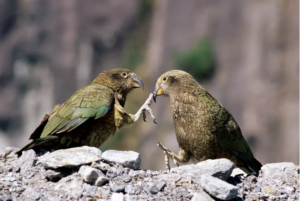
Kea parrots at Willowbank Wildlife Reserve in New Zealand emit distinctive “warble calls” when they’re playing, and researchers are now using body temperature, hormone levels, and vocalisation patterns to distinguish genuine joy from plain old stimulation. When keas received an unexpected favourite food, their behaviour changed measurably and meaningfully.
A study published in Applied Animal Behaviour Science added weight to this body of work: across 23 species of zoo-housed carnivores, it was environmental enrichment – and not biological variables like body size, range, or sociality – that most reliably predicted positive welfare indicators like activity, play, and environmental interaction.
The animals with access to enrichment simply did better. They engaged more. They played more. They lived more.
This is exactly what the Captive Animal Enrichment Project (CAEP) was founded for!
Based in Cape Town, South Africa, CAEP devotes its funding and projects entirely to enrichment. Not because it is the easiest intervention, but because the evidence increasingly confirms it is among the most powerful. CAEP works with animals living in ethical welfare organisations, designing and implementing novel enrichment strategies that encourage natural behaviours, alleviate boredom, and support physical and psychological wellness.
Our guiding light and our greatest conviction is simple: the VALUE of a life saved is the QUALITY of that life. An animal that is merely alive can’t really be compared to an animal that is living well. One that forages, explores, plays, and engages with their environment is experiencing something categorically richer than one that simply exists within it. The science of positive affect is not a soft concern – it is a precise, measurable, and increasingly urgent one.

The question “is this animal happy?” is not a philosophical one anymore. It is empirical. And the answers have direct implications for how we design the lives of animals in our care – in ethical sanctuaries and zoos, on farms, and in homes.
At CAEP we know that enrichment is the most direct, evidence-based pathway to a life that is not just something to be survived, but genuinely worthliving to the full. Every project we undertake is an investment in that belief. We welcome collaboration, partnership, and support from anyone who shares it.


